Here we are in September! In my humble opinion, September is a much better time to start new habits to support your health than January is. September has that back-to-school vibe, and we are probably all conditioned, to some degree, to want to mark the end of the summer by getting back into routine and being organised. When you think about how we want to seek comfort in the cold, dark days of January, it shouldn’t be a surprise that new habits may be easier to embed in September!
When I think both of being organised and of nutrition, I always think of meal prepping. You have probably heard the saying (which is attributed to Benjamin Franklin), “By failing to prepare, you are preparing to fail.” I prefer to give it a more positive twist, saying, “By successfully preparing, you are preparing to succeed.” Either way, the message is clear: if you want to achieve your goals, some planning and preparation is needed.
This is especially true when it comes to nutrition. We can have all the best intentions in the world of making nourishing, anti-inflammatory meals, but if we arrive home from work late and there’s not much in the fridge, we’re likely to end up phoning for a takeaway or grabbing a ready meal out of the freezer. Of course, there’s nothing wrong with enjoying a takeaway intentionally from time to time if it brings you joy. However, if you are clear on your desire to eat well for the sake of your health and your recovery, but you never seem to have enough time, or circumstances always conspire against you, then it’s likely that meal prepping could help you achieve that goal.

What can you Prepare Ahead of Time?
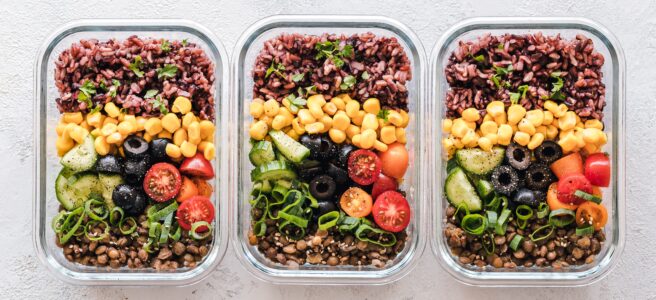
The aim of meal prepping is that by doing it when you have more time (for example, at the weekend), you are more likely to be able to grab something healthy when you need a meal in a hurry or when you don’t have the energy to prepare it. You can make full meals ahead of time, but any element of preparation that you can do will help. Examples of meal prepping include:
- Batch cook soups, stews, curries and chillis; make at least double the amount you need for one meal and save the leftovers in individual portion sizes in the fridge or freezer.
- Make protein items for packed lunches in advance: bean burgers, falafel, houmous, frittata or egg muffins, fish pâté, hard boiled eggs.
- Roast a large tray of rainbow vegetables such as courgette, red onion, aubergine, cherry tomatoes, yellow and orange peppers with garlic and fresh herbs, then store in individual portions. You can eat these as a side dish during the week, add to an omelette, or combine with quinoa to make a salad.
- Roast a chicken at the weekend that is bigger than the size you need for one meal. You will then have plenty of cooked chicken to use in soups, stir fries or salads during the week.
- Chop vegetables into crudités and store in the fridge. Having vegetables to hand to dip into houmous or guacamole means that you are increasing your vegetable intake even when you snack.
- You can also chop vegetables ready for stir fries or to add to pasta sauces ahead of time. It’s true that the amounts of some nutrients will decrease the earlier they are chopped, but if this tip makes it more likely that you will add veggies to your dishes, then some veg nutrients is better than none.
- Prepare breakfasts the night before: make overnight oats, defrost frozen berries, have some egg muffins ready in the fridge or put the dry ingredients for a smoothie in the blender cup.
- Make salad dressings ahead of time and store in jars in the fridge. A great dressing can transform a salad.
- Don’t be afraid of buying ready prepped items: salad bags, stir fry mixes, root veg soup mixes, ready chopped onions etc. We all have to make compromises in life and you are doing the best you can.

Other Benefits of Meal Prepping
By now, it should be clear that prepping meals for several days ahead requires a bit of advance planning. You have to work out how many days you are preparing food for and what you are going to eat (and not eat!) on those days. We tend to be much better at planning nutritious, balanced meals in advance than we are at creating nutritious, balanced meals when we arrive home from work tired and with nothing planned! Planning and prepping meals forces you into thinking about the individual components of each meal, so that you stand more chance of including sufficient good quality protein, healthy fats and plenty of vegetables.
An additional benefit is that by deciding what you are going to eat in advance, your grocery shopping will be more focused, saving you money and reducing food waste. I promise you that this is worth the time that you set aside to plan and prep.
A Note on Storage

Finally, all this meal prepping may mean that you need to buy some new food storage containers. If this is the case, then I would urge you to buy glass, stainless steel or ceramic where possible, particularly for storing warm food. Plastic containers, even those that are BPA-free, can leach microplastic particles and potentially endocrine disrupting chemicals into the food in contact with them(1); all the more so if the food is hot, oily or fatty, or acidic (such as tomatoes).
If you are taking some of your prepared meals to work or away from home, then I recommend the stainless steel lunch boxes made by Black & Blum. They are much lighter than carrying glass boxes around, and have a fantastic seal on the lid that makes them completely leak-proof. They also make stackable stainless steel meal prep sets which look good, although I have not tried them myself. (I have no affiliation with Black & Blum.) Several food flasks that I have tried have not kept the food warm for long enough, but a trusty Thermos flask has kept soup warm for at least 7 hours.
Have you recently started doing more meal planning and prepping? I’d love to hear about any benefits you’ve found.
References
- Yang, C.Z., Yaniger, S.I., Jordan, V.C. et al. (2011). ‘Most Plastic Products Release Estrogenic Chemicals: A Potential Health Problem That Can Be Solved’, Environmental Health Perspectives, 119(7), pp989-996. Available at https://www.ncbi.nlm.nih.gov/pmc/articles/PMC3222987/